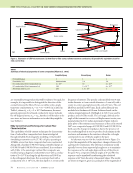
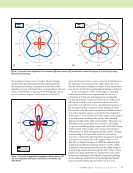
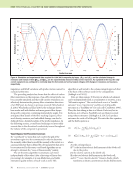
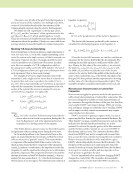
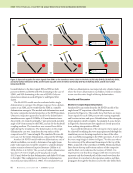
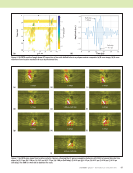
46 M A T E R I A L S E V A L U A T I O N • J A N U A R Y 2 0 2 0 l No clear distinction was observed between the proposed meta-model (learned from real acquisi- tions) and the real acquisitions. l A physical simulation combined with ultrasonic texture also reaches a good degree of realism however, the difficulty to properly set up the correct material properties tends to degrade the realism. Conclusion and Future Work We have presented the concept of “operational NDT simulation” with the potential to perform simulation- assisted POD studies accounting for human factors. Several other applications, such as operator training, can benefit from this concept. The technical solutions to tackle the simulation challenges related to signal realism and ultrafast computations are presented for the use case of PAUT of composite materials. The core strategy is based on an augmented signal approach that combines real signals and simulated ones to get real-time and realistic signals. Regarding the simula- tions, data-driven solutions are developed to ensure a good match between reality and simulation without requiring any prior characterization of the material properties. A prototype of such an operational NDT simulator has been implemented for the case of PAUT of composite materials. Feedback collected from inspectors using the prototype shows that they can be convinced that the inspection is real. Next steps could be to propose the prototype during NDT training sessions to collect more feedback and improve the system. Additionally, the extension of the concept to other types of defects such as impact damage in composites is of great interest to be able to evaluate a POD assisted by operational simulation in this case. Application of the concept to other types of structures, materials, defects, or NDT techniques will require the development of new dedicated models. However, we hope that the experience gained and reported in this paper, especially the prototype development strategy based on mixing real-world and synthetic signals, will help broaden operational NDT simulation use cases. w AUTHORS Damien Rodat: Airbus SAS, Ringgold Standard Institution, 2 Rond-Point Émile Dewoitine, Blagnac, Occitanie 31707, France damien.rodat@u-psud.fr Nicolas Dominguez: Airbus SAS, Ringgold Standard Institu- tion, 2 Rond-Point Émile Dewoitine, Blagnac, Occitanie 31707, France Frank Guibert: Testia, 18 Rue Marius Tercé, Toulouse, Occitanie 31024, France Pierre Calmon: CEA LIST, Ringgold Standard Institution – DIGITEO Saclay, Bât. 565, Gif-sur-Yvette, Île-de-France 91191, France REFERENCES Calmon, P., S. Mahaut, S. Chatillon, and R. Raillon, 2006, “CIVA: An Expertise Platform for Simulation and Processing NDT Data,” Ultrasonics, Vol. 44, pp. e975–e979. Dong, Y., S. Lefebvre, X. Tong, and G. Drettakis, 2008, “Lazy Solid Texture Synthesis,” Computer Graphics Forum, Vol. 27, No. 4, pp. 1165–1174. Dominguez, N., and D. Simonet, 2014, “Method of Simu- lating Operations of Non-Destructive Testing under Real Conditions using Synthetic Signals,” US Patent No. US20140047934A1, 20 February 2014 available at https://patents.google.com/patent/US20140047934A1/en. Efros, A.A., and T.K. Leung, 1999, “Texture Synthesis by Non-Parametric Sampling,” IEEE International Conference on Computer Vision, Corfu, Greece, doi: 10.1109/ICCV.1999 .790383. Guibert, F., M. Rafrafi, D. Rodat, E. Prothon, N. Dominguez, and S. Rolet, 2016, “Smart NDT Tools: Connection and Automation for Efficient and Reliable NDT Operations,” 19th World Conference on Non-Destructive Testing, Munich, Germany. Pati, Y.C., R. Rezaiifar, and P.S. Krishnaprasad, 1993, “Orthogonal Matching Pursuit: Recursive Function Approxi- mation with Applications to Wavelet Decomposition,” Proceedings of 27th Asilomar Conference on Signals, Systems and Computers, Pacific Grove, CA, doi: 10.1109/ACSSC.1993.342465. Rasmussen, C.E., and C.K.I. Williams, 2006, Gaussian Processes for Machine Learning, The MIT Press, Cambridge, MA. Rodat, D., F. Guibert, N. Dominguez, and P. Calmon, 2018a, “Data-Driven Modelling Approaches Combined to Physical Models for Real-Time Realistic Simulations,” 12th European Conference on Non-Destructive Testing, Gothenburg, Sweden. Rodat, D., F. Guibert, N. Dominguez, and P. Calmon, 2018b, “Introduction of Physical Knowledge in Kriging-Based Meta- Modelling Approaches Applied to Non-Destructive Testing Simulations,” Simulation Modelling Practice Theory, Vol. 87, pp. 35–47. ME FEATURE w operational ndt simulations Next steps could be to propose the prototype during NDT training sessions to collect more feedback and improve the system.

ASNT grants non-exclusive, non-transferable license of this material to  .
All rights reserved. © ASNT 2026. To report unauthorized use, contact: customersupport@asnt.org